Walking into Istanbul Grill Restaurant here in America, one of the most common questions we hear from both Muslim and non-Muslim customers is: “Is your beef halal?” This question matters deeply to millions of Muslims living in the United States who want to follow their faith while enjoying delicious food.
Yes, beef is halal when it meets specific Islamic requirements. However, not all beef automatically qualifies as halal. The animal must be slaughtered according to Islamic law, handled properly, and kept free from contamination.
What Does Halal Mean?
Halal is an Arabic word meaning “permissible” or “lawful” under Islamic law. The opposite is haram, meaning “forbidden.” For Muslims, eating halal is not a preference but a religious obligation commanded in the Quran.
The Quran states: “O you who believe! Eat of the good things that We have provided for you, and be grateful to Allah if it is Him you worship.” (Quran 2:172)
When it comes to food, halal covers:
- What type of food you can eat
- How that food must be prepared
- Where it comes from
- How it is stored and served
Key Requirements for Halal Beef
For beef to be truly halal according to Islamic dietary guidelines, it must meet these essential conditions:
1. The Animal Must Be Permissible
Cows and cattle are among the animals Islam allows Muslims to eat. The Islamic Food and Nutrition Council of America (IFANCA) confirms that cattle are halal animals when properly slaughtered.
Permissible animals include:
- Cows and cattle
- Sheep and lamb
- Goats
- Buffalo
Forbidden (haram) animals include:
- Pigs and swine
- Carnivorous animals
- Animals that died before slaughter
- Animals not slaughtered in Allah’s name
2. The Animal Must Be Healthy
The cow must be alive, healthy, and free from disease at the time of slaughter. Any animal that dies before proper slaughter is not halal.
3. Proper Slaughter Method (Zabiha)
The Islamic slaughter method is called Zabiha or Dhabiha. This process requires:
- Step 1: A Muslim must perform the slaughter
- Step 2: The name of Allah must be invoked by saying “Bismillah, Allahu Akbar” (In the name of Allah, Allah is the Greatest)
- Step 3: A sharp knife must be used for a swift cut
- Step 4: The cut must sever the windpipe, esophagus, and both jugular veins
- Step 5: The spinal cord must NOT be severed
- Step 6: All blood must be completely drained from the body
The Quran prohibits blood consumption: “Forbidden to you are: dead meat, blood, the flesh of swine, and that on which has been invoked the name of other than Allah…” (Quran 5:3)
According to the Halal Food Authority, this method ensures the quickest, most humane death while following divine commandments.
4. No Cross-Contamination
After slaughter, the beef must be:
- Processed separately from haram foods like pork
- Handled with dedicated halal equipment
- Stored away from non-halal products
- Kept free from alcohol and other forbidden substances
Nutritional Benefits of Halal Beef
Halal beef provides essential nutrients that support overall health. Here is the nutritional breakdown for a 3-ounce (85g) serving of cooked lean beef:
Nutritional Content (per 3 oz serving)
| Nutrient | Amount | % Daily Value |
|---|---|---|
| Calories | 180 | – |
| Protein | 25g | 50% |
| Total Fat | 8g | 10% |
| Saturated Fat | 3g | 15% |
| Iron | 2.5mg | 14% |
| Zinc | 5mg | 45% |
| Vitamin B12 | 2.4mcg | 100% |
| Niacin (B3) | 6mg | 30% |
| Selenium | 26mcg | 47% |
Source: USDA FoodData Central
Key Health Benefits
- High-Quality Protein: Beef provides complete protein with all nine essential amino acids needed for muscle growth and tissue repair.
- Rich in Iron: The iron in beef is heme iron, which your body absorbs more easily than plant-based iron. This helps prevent anemia and supports oxygen transport throughout the body.
- Vitamin B12: Essential for nerve function and red blood cell formation. Beef is one of the best natural sources of B12.
- Zinc Support: Supports immune function, wound healing, and DNA synthesis.
- Blood Drainage Benefits: The halal requirement to drain all blood may reduce bacteria levels, as blood can be a medium for bacterial growth.
Understanding Halal Certification
Halal certification ensures that beef meets Islamic requirements from farm to table. Recognized certification bodies include:
Major Halal Certification Organizations
In the United States:
- IFANCA (Islamic Food and Nutrition Council of America)
- ISA (Islamic Services of America)
- American Halal Foundation
International Bodies:
- JAKIM (Malaysia) – Gold standard worldwide
- HFA (Halal Food Authority) – United Kingdom
- HMC (Halal Monitoring Committee) – UK
- SANHA – South Africa
When shopping, look for certification logos that include:
- The certifying organization’s name
- A certification number
- Contact information for verification
Where Can I Buy Halal Beef?
Finding halal beef in America has become easier as Muslim communities grow. Here are your best options:
1. Dedicated Halal Butcher Shops
Best choice for reliability and selection
Advantages:
- Expert knowledge of Islamic requirements
- Fresh, high-quality cuts
- Ability to answer detailed questions
- Support for Muslim-owned businesses
How to find: Search “halal butcher near me” or ask at your local mosque for recommendations.
2. Major Supermarket Chains
Many mainstream stores now carry halal products:
- Whole Foods Market
- Walmart (in diverse areas)
- Costco (bulk halal options)
- Kroger and regional chains
Shopping tip: Look for packages with clear halal certification logos. Ask the meat department manager if halal beef is available or can be special ordered.
3. Online Halal Meat Delivery
Convenient for those in areas without local halal options:
- Ships frozen to your door
- Wide selection of cuts
- Often includes organic and grass-fed options
Research tip: Check customer reviews and verify halal certification before ordering.
4. Halal Restaurants
At Istanbul Grill Restaurant, all our beef is certified halal. We serve American customers who want authentic Mediterranean cuisine while ensuring Muslim diners can eat with confidence.
When dining out, always:
- Ask if beef is halal certified (not just “halal-friendly”)
- Request to see certification if unsure
- Inquire about cross-contamination practices
How to Verify Beef is Truly Halal
Follow these steps when purchasing:
Step 1: Look for halal certification logo on packaging
Step 2: Identify the certifying organization
Step 3: Verify the organization is reputable (check online)
Step 4: Ask about the slaughter process if buying from butchers
Step 5: Inquire about cross-contamination prevention
Step 6: Check for proper storage (separate from pork)
Step 7: When in doubt, contact the certification body directly
Common Misconceptions About Halal Beef
Myth 1: All Beef is Automatically Halal
Truth: Even though cows are permissible animals, beef is only halal when slaughtered and handled according to Islamic law.
Myth 2: Halal Equals Organic
Truth: These are separate certifications. Beef can be organic but not halal, halal but not organic, or both.
Myth 3: Halal and Kosher Are the Same
Truth: While similar (both forbid pork and require specific slaughter), there are important differences. Most scholars say kosher meat is acceptable for Muslims in certain circumstances, but it is not identical to halal.
Myth 4: Price Determines Halal Quality
Truth: Expensive beef is not necessarily more halal. Focus on proper certification, not price alone.
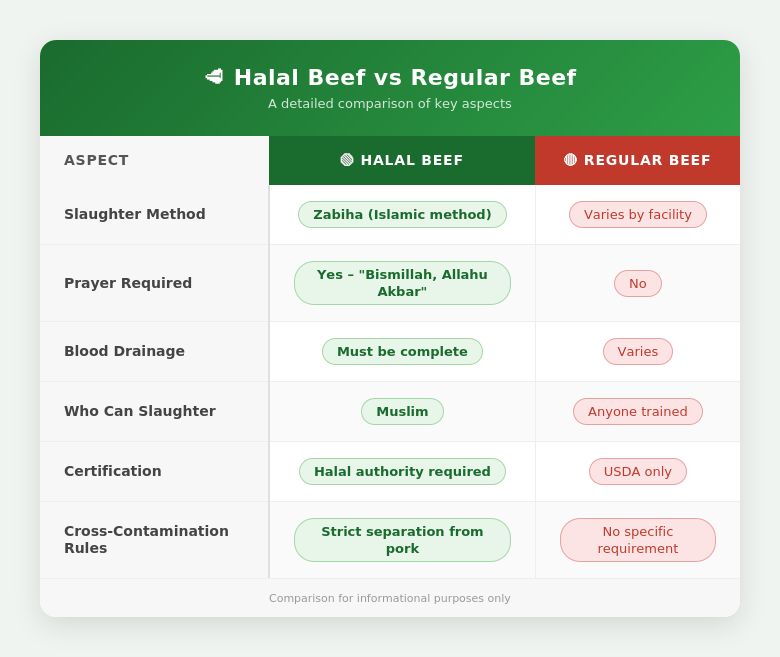
Halal Beef vs. Regular Beef: Key Differences
Storing and Preparing Halal Beef
Storage Guidelines
Refrigerator (40°F or below):
- Ground beef: 1-2 days
- Steaks and roasts: 3-5 days
Freezer (0°F or below):
- Ground beef: 3-4 months
- Steaks and roasts: 6-12 months
Important: Freezing does not affect halal status.
Preventing Cross-Contamination at Home
- Store halal and non-halal meats separately
- Use different cutting boards (color-code them)
- Clean surfaces thoroughly between uses
- Wash hands after handling non-halal meat
Cooking Tips
Halal beef can be prepared using any method:
- Grilling and barbecuing
- Pan-frying or roasting
- Slow cooking
- Braising or stewing
Caution: Avoid marinades containing wine or alcohol. Check that Worcestershire sauce and soy sauce are halal (some contain alcohol).
Popular Halal Beef Dishes
Traditional Middle Eastern
At Istanbul Grill Restaurant, we serve:
- Beef Kebabs – Marinated chunks grilled on skewers
- Kofta – Spiced ground beef cylinders
- Shawarma – Thinly sliced marinated beef
- Beef Hummus – Hummus topped with seasoned ground beef
American Favorites
- Hamburgers and cheeseburgers
- Beef tacos and burritos
- Meatloaf
- Pot roast
- Beef chili
- Philly cheesesteak
International Cuisine
- Beef curry (Indian/Thai)
- Bulgogi (Korean)
- Beef pho (Vietnamese)
- Rendang (Indonesian)
Conclusion
At Istanbul Grill Restaurant, we understand that halal beef is more than just food for our Muslim customers – it is an important part of practicing their faith. For beef to be truly halal, it must meet specific Islamic requirements during slaughter, processing, and storage.
Key points to remember:
- Beef is halal only when properly slaughtered and handled
- Always look for certification from recognized authorities
- Ask questions when unsure about halal status
- Store halal beef separately from non-halal items
- When in doubt, choose certified halal options
Whether you are Muslim seeking to follow Islamic dietary laws or simply curious about halal practices, understanding these requirements helps you make informed choices. The Islamic Food and Nutrition Council of America provides additional resources for those wanting to learn more about halal certification standards.
For Muslims in America, following halal dietary laws is a way to honor Allah’s commands in daily life. For non-Muslims, learning about halal shows respect for diverse religious practices in our communities.
Visit Istanbul Grill Restaurant to experience authentic halal beef prepared with care, respect, and adherence to Islamic principles. Every meal is an opportunity to enjoy delicious food while honoring faith and tradition.