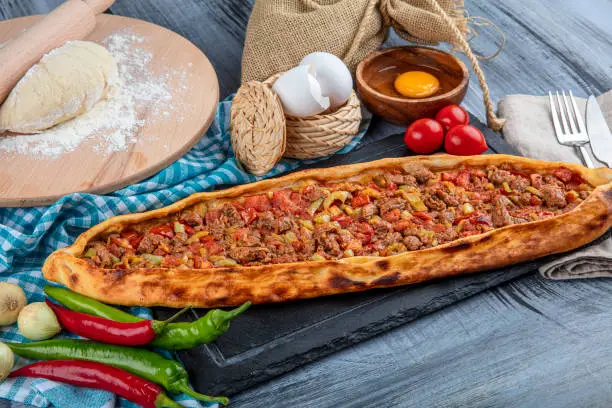
There is something magical about pulling a golden, boat-shaped Turkish pide out of your oven. The smell fills your kitchen. The cheese bubbles and melts. Your family gathers around the table. This is what Turkish pide does – it brings people together.
At Istanbul Grill Restaurant in Orlando and Kissimmee, we serve authentic Turkish pide every single day. We see how much our customers love it. Now, we want to show you how easy it is to make this delicious Turkish food at home.
What is Turkish Pide?
Turkish pide is a traditional flatbread from Turkey. People often call it “Turkish pizza,” but that does not tell the whole story. Pide has its own special character.
The bread is shaped like a boat or canoe. Bakers fold the edges up to hold the toppings inside. The crust is crispy and golden. The inside stays soft and chewy. Unlike pizza, pide does not use tomato sauce as a base. Instead, the toppings sit right on the dough with melted cheese.
Turkish families have been making pide for hundreds of years. In Turkey, you can find special shops called “pideci” that only make pide all day long. Each region has its own style. Some make it round. Others keep it long and narrow. But the love for this food stays the same everywhere.
Why You Will Love This Recipe
Making Turkish pide at home is easier than you think. You do not need special equipment. A regular oven works perfectly fine. The ingredients are simple – just flour, yeast, water, and your favorite toppings.
This recipe for Turkish pide bread takes about two hours from start to finish. Most of that time is just waiting for the dough to rise. You can relax, prepare your toppings, or do other things while the dough does its work.
The best part? You can make pide exactly how you want it. Add extra cheese. Load it with vegetables. Make it with ground beef or lamb. The choice is yours.
Ingredients You Need
For the Pide Dough:
- 3 cups all-purpose flour (plus extra for dusting)
- 1 packet instant yeast (2 ¼ teaspoons)
- 1 tablespoon sugar
- 1 teaspoon salt
- 2 tablespoons olive oil
- 1 cup warm water (not hot, just warm to touch)
For Simple Cheese Topping:
- 2 cups shredded mozzarella cheese
- 1 cup crumbled feta cheese
- 1 egg (for brushing)
- 2 tablespoons sesame seeds or nigella seeds
Optional Add-Ins:
- Fresh spinach (chopped)
- Red bell peppers (sliced thin)
- Ground beef or lamb (cooked and seasoned)
- Turkish sausage (sucuk), if you can find it
- Onions (diced)
- Mushrooms (sliced)
How to Make Turkish Pide Bread: Step by Step
Step 1: Wake Up the Yeast
Pour the warm water into a small bowl. Add the sugar and yeast. Stir gently with a spoon. Let it sit for 5 to 8 minutes.
You will know the yeast is ready when you see foam on top. This foam means your yeast is alive and working. If you do not see any foam, your yeast might be too old. Try again with fresh yeast.
Important tip: The water should feel warm, not hot. If the water is too hot, it will kill the yeast. If it is too cold, the yeast will not wake up. Think of bath water temperature – comfortable and warm.
Step 2: Make the Dough
Put the flour and salt in a large bowl. Mix them together. Make a small well in the center. Pour in the yeast mixture and olive oil.
Start mixing with a wooden spoon. When the dough gets too thick to stir, use your hands. The dough will feel sticky at first. This is normal.
Sprinkle a little flour on your counter. Put the dough on the counter. Now comes the fun part – kneading.
Push the dough away from you with your palms. Fold it back. Turn it a quarter turn. Push again. Keep doing this for about 8 to 10 minutes. The dough will change. It will become smooth and elastic. It will stop sticking to your hands.
How do you know when you are done? Press your finger gently into the dough. If it bounces back slowly, you are ready for the next step.
Step 3: Let the Dough Rise
Rub a little olive oil inside a clean bowl. Place your dough ball in the bowl. Turn it around so all sides get a light coating of oil. This keeps the dough from drying out.
Cover the bowl with a clean kitchen towel or plastic wrap. Put it somewhere warm in your kitchen. Near (not on) a warm oven works great. A sunny spot on the counter is good too.
Wait for 1 hour to 90 minutes. The dough should double in size. It will look puffy and soft.
Step 4: Prepare Your Toppings
While the dough rises, get your toppings ready. This is when you can be creative.
For a simple cheese pide: Mix the mozzarella and feta in a bowl. That is it. Easy and delicious.
For a meat pide: Cook ground beef or lamb in a pan with diced onions, salt, pepper, and a pinch of cumin. Let it cool before using.
For a veggie pide: Sauté spinach with a little garlic until wilted. Slice your peppers and mushrooms thin. Let everything cool.
Pro tip from Istanbul Grill: Always let cooked toppings cool down before putting them on the dough. Hot toppings can make the dough soggy.
Step 5: Shape the Pide
Your dough has doubled in size. Perfect! Punch it down gently with your fist. This releases the air bubbles.
Turn the dough onto a floured counter. Cut it into 3 equal pieces. Roll each piece into a ball.
Take one ball. Use a rolling pin to roll it into an oval shape. Make it about 12 inches long and 6 inches wide. The dough should be about ¼ inch thick. Not too thin, not too thick.
If the dough keeps shrinking back, let it rest for 5 minutes. Then try again. The gluten needs time to relax.
Place your oval on a baking sheet. You can line the sheet with parchment paper to prevent sticking.
Step 6: Add the Toppings
Sprinkle cheese over the dough. Leave about 1 inch of space around all the edges. This border is important.
Add your other toppings on top of the cheese. Do not pile them too high. A nice even layer works best.
Now fold the long edges of the dough up and over, just covering the outer edge of the toppings. Press gently. The center should still show the fillings. This creates that classic boat shape.
Pinch both ends together tightly. Twist them a little to make pointed tips. Your pide should look like a canoe or boat now.
Step 7: The Final Touches
Beat one egg in a small bowl. Use a brush to paint the folded edges with egg. This gives the crust a beautiful golden color when it bakes.
Sprinkle sesame seeds or nigella seeds on the egg-washed edges. This adds a nice crunch and authentic Turkish flavor.
Step 8: Bake to Perfection
Put your oven rack in the middle position. Preheat your oven to 450°F. Let it get really hot.
Bake the pide for 12 to 15 minutes. Watch for these signs that it is ready:
- The crust turns golden brown
- The cheese bubbles and gets spots of brown
- The edges look crispy
- The bottom is firm (lift carefully to check)
Take the pide out of the oven. Let it cool for 2 to 3 minutes. This helps the cheese set a little.
Step 9: Slice and Serve
Use a pizza cutter or sharp knife to cut the pide. Cut it crosswise into 2-inch wide pieces. Each piece should be easy to pick up and eat with your hands.
Serve it hot. This is when Turkish pide tastes best – right out of the oven, with the cheese still melting.
Nutritional Breakdown
Energy Content: 812 calories (41% of daily intake)
Main Nutrients:
- Carbohydrates: 105g (35% daily value)
- Protein: 39g (78% daily value)
- Fat: 27g (42% daily value)
- Including Saturated Fat: 11g (69% daily value)
- Dietary Fiber: 8g (33% daily value)
- Sugars: 4g (4% daily value)
Essential Vitamins:
- Vitamin A: 13,647 IU (273% daily value)
- Vitamin C: 41mg (50% daily value)
Important Minerals:
- Calcium: 555mg (56% daily value)
- Iron: 6mg (33% daily value)
- Potassium: 1,079mg (31% daily value)
- Sodium: 1,756mg (76% daily value)
Additional Information:
- Cholesterol: 59mg (20% daily value)
Percentages are based on a standard 2,000 calorie daily diet
Tips for Perfect Turkish Pide Every Time
Use instant yeast, not active dry yeast: Instant yeast works faster and mixes right into the flour. If you only have active dry yeast, it works too. Just add 5 extra minutes to the rising time.
Keep your dough warm while rising: Cold kitchens slow down the yeast. If your kitchen is cold, turn your oven on for just 1 minute, then turn it off. Put the covered dough bowl in the warm (not hot) oven to rise.
Do not overload with toppings: Too many toppings make the pide soggy and hard to fold. Less is more. You want to taste the bread, not just the toppings.
Work quickly once shaped: Once you roll out the dough and add toppings, get it in the oven soon. If the dough sits too long, the moisture from toppings can make it wet.
Bake on the middle rack: This gives even heat from top and bottom. Your pide will cook evenly.
Check the bottom: A perfectly cooked pide has a crispy bottom. If your bottom stays pale and soft, your oven might not be hot enough. Try baking a few minutes longer next time.
Common Mistakes to Avoid
Mistake 1: Using hot water for yeast Hot water kills yeast. Always test the water temperature with your finger first. It should feel warm and comfortable, never hot.
Mistake 2: Not kneading long enough Under-kneaded dough makes dense, heavy pide. Take your time. Knead for the full 8 to 10 minutes. Your arms might get tired, but the result is worth it.
Mistake 3: Skipping the rise time We know you are hungry and excited. But do not rush the rise. The dough needs this time to develop flavor and texture. Shortening the rise time gives you flat, tough pide.
Mistake 4: Rolling the dough too thin Thin dough tears easily and gets crispy all over, like a cracker. You want some thickness so the inside stays soft and bread-like.
Mistake 5: Adding hot or wet toppings This is the biggest mistake we see at Istanbul Grill. Always cool and drain your toppings first. Pat spinach dry with paper towels. Let cooked meat cool completely.
How to Store and Reheat Turkish Pide
Storing: Let leftover pide cool completely. Wrap each piece in plastic wrap or foil. Keep in the refrigerator for up to 3 days.
Freezing: Turkish pide freezes beautifully. Wrap cooled pieces tightly in foil, then put them in a freezer bag. Freeze for up to 3 months. No need to thaw before reheating.
Reheating: Put pide on a baking sheet. Heat in a 375°F oven for 8 to 10 minutes if refrigerated, 12 to 15 minutes if frozen. The crust gets crispy again, and the cheese melts perfectly. Do not use the microwave – it makes the bread soggy and chewy.
Why Turkish Pide is Different from Pizza
People ask us this question all the time at Istanbul Grill. Yes, both are flatbreads with toppings. But they are quite different.
The shape: Pizza is round and flat. Pide is oval and boat-shaped with folded edges.
The base: Pizza uses tomato sauce. Pide bread goes straight to the toppings without sauce.
The texture: Pizza crust can be thin and crispy, thick and doughy, or somewhere between. Pide has a specific texture – crispy outside, soft and slightly chewy inside.
The toppings: Pizza loves Italian flavors – pepperoni, Italian sausage and Italian herbs. Pide uses Middle Eastern and Turkish flavors – feta cheese, lamb, Turkish spices and fresh vegetables.
How you eat it: Pizza comes in triangle slices. Pide is cut into rectangular pieces across the width of the boat. Both taste amazing.
Serving Suggestions
Turkish pide makes a complete meal on its own. But here are some sides that go wonderfully with it:
- Simple cucumber and tomato salad with olive oil and lemon
- Turkish lentil soup (mercimek çorbası)
- Yogurt sauce with garlic and mint
- Pickled vegetables (turşu)
- Fresh herbs like parsley, mint, and dill on the side
- Hot tea (çay) – the Turkish way to end a meal
At Istanbul Grill, we always serve pide with a small salad and yogurt sauce. The cool, tangy yogurt balances the rich, warm bread perfectly.
Your Turn to Make Turkish Pide
Now you know how to make Turkish pide bread at home. You have the recipe. You know the tips and tricks. You understand what makes great pide different from okay pide.
The most important ingredient is not in the recipe – it is the love and care you put into making it. Take your time. Enjoy the process. Let your kitchen fill with that amazing smell.
When you pull your first homemade pide from the oven, you will feel proud. When your family tastes it, they will be amazed. They might even think you ordered it from a Turkish restaurant.
Making traditional Turkish food at home connects you to a culture that is thousands of years old. Every bite of pide tells a story – of Turkish bakers, of family gatherings, of simple ingredients becoming something special.
We hope this recipe for Turkish pide bread brings joy to your kitchen. If you ever visit Orlando or Kissimmee, stop by Istanbul Grill Restaurant. We would love to serve you authentic pide made the traditional way. Until then, happy baking!
FAQs
[rank_math_rich_snippet id=”s-b3049858-7c4b-4f5a-8209-16f79c8d57ff”]