You are standing in the checkout line. Your child picks up a bag of gummy bears and drops it in the cart. You flip it over, scan the ingredient list, and there it is: gelatin. Is it from pork? From beef? From fish? The label does not say.
This happens to Muslim families across America every single day. Gelatin is one of the most hidden and misunderstood ingredients in the American food supply. At Istanbul Grill Restaurant, we prepare all our food to certified halal standards and never use hidden haram ingredients. But we also want to help our community make confident choices beyond our restaurant walls.
This complete guide answers every question you have about gelatin, once and for all.
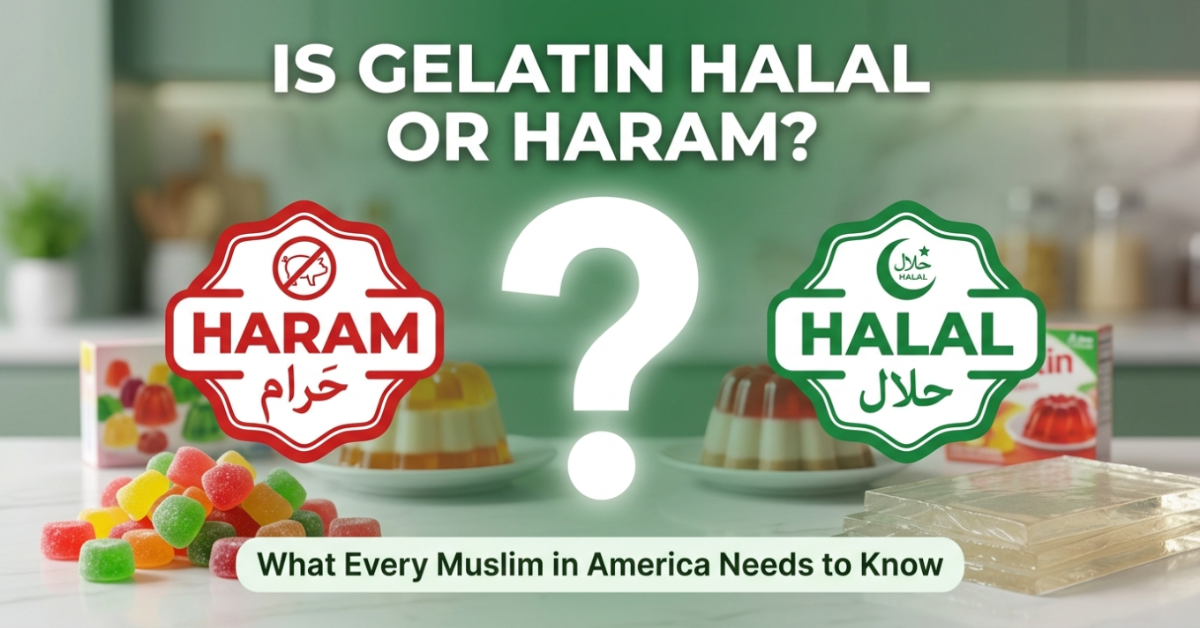
The Short Answer: It Depends on the Source
| Gelatin Type | Halal Status |
|---|---|
| Pork gelatin | Always haram — no exceptions |
| Beef gelatin without halal certification | Haram or doubtful |
| Beef gelatin with halal certification | Halal |
| Fish gelatin | Always halal — no conditions |
| Plant-based alternatives (agar-agar, pectin) | Always halal — no conditions |
The problem is that most gelatin labels in America simply say “gelatin” with no source listed. According to 2026 research, between 60 and 80 percent of all gelatin used in Western food products comes from pigs. If a label just says “gelatin” with no halal certification logo, assume it is most likely from pork.
What is Gelatin?
Gelatin is a protein made by boiling the skin, bones, tendons, and connective tissue of animals, usually pigs or cows, in water for a long time. The collagen breaks down into gelatin, which is then dried and ground into a fine powder.
This powder is colorless, odorless, and flavorless, which is why it hides so easily in food without you noticing it. It dissolves in hot water and forms a gel when cooled, making it invaluable to the food industry for creating texture in hundreds of products.
Gelatin also appears in pharmaceutical capsules, vitamin supplements, and cosmetics, which is why understanding its sources matters so much for Muslims in everyday life.
Is Pork Gelatin Always Haram?
Yes, without any exception or debate.
The Quran explicitly prohibits pork in Surah Al-Baqarah (2:173): “Forbidden to you are carrion, blood, the flesh of swine, and that which has been dedicated to other than Allah.”
All four major Sunni schools of Islamic law, Hanafi, Maliki, Shafi’i, and Hanbali, agree completely that pork gelatin is haram. Some manufacturers argue that gelatin is so heavily processed that it no longer resembles pork. This argument is rejected by virtually all contemporary Islamic scholars and by IFANCA (Islamic Food and Nutrition Council of America), the most respected halal certification body in the USA.
Is Beef Gelatin Halal?
This is where the question gets complicated.
Beef comes from cows, which are permissible animals in Islam. But as we explain in our guide on what is the difference between halal meat and regular meat, a permissible animal does not automatically produce halal products. The cow must also be slaughtered according to Islamic zabiha requirements.
In the United States, the vast majority of beef is not slaughtered according to zabiha standards. Animals are typically stunned before slaughter, the name of Allah is not invoked, and the slaughter is not performed by a Muslim. This means that most beef gelatin produced from American cattle is not halal.
According to IslamQA, one of the most widely referenced Islamic scholarly resources: gelatin from animals slaughtered in the West is generally haram because Western slaughter practices do not follow zabiha requirements.
The Golden Rule is simple: if the label says “gelatin” with no source and no halal certification logo, treat it as haram.
Is Fish Gelatin Halal?
Yes, always and with no conditions.
Under Islamic law, fish do not require a specific slaughter method to be permissible. Fish gelatin is therefore always halal, making it an excellent alternative. Unfortunately, fish gelatin is more expensive and far less common in mass-market products.
How to Spot Hidden Gelatin on Labels
Gelatin does not always appear as the word “gelatin.” It hides under multiple names. Watch for all of these on ingredient lists:
- Gelatin or Gelatine (UK spelling)
- E441 (the European food code for gelatin)
- Hydrolyzed collagen
- Collagen peptides
- Collagen hydrolysate
- Bovine collagen (still needs halal certification)
- Marine collagen (usually from fish, generally halal)
According to HalalCodeCheck, also watch for E120 (carmine), a red and pink food coloring made from insects that is haram. When checking a product for gelatin, check for E120 at the same time.
Everyday American Foods That Contain Hidden Gelatin
Most Muslims know gummy candies and marshmallows contain gelatin. But it hides in many products that seem safe:
- Candy and Sweets: Gummy bears, marshmallows, candy corn, certain chocolate-covered candies, fruit chews
- Dairy Products: Some yogurts (especially low-fat), certain cream cheeses, some ice creams
- Health Products: Most pharmaceutical capsules, vitamin supplements in capsule form, fish oil and omega-3 capsules, many collagen powder products
- Beverages: Some fruit juices (gelatin used as a fining agent, not always listed), certain protein shakes
- Other: Some canned meats, certain salad dressings, jello and gelatin dessert mixes
How to Read Labels: 5 Simple Steps
- Step 1: Look for a recognized halal certification logo first. IFANCA, ISA, ISWA, or the Halal Monitoring Committee logos mean the gelatin has been verified as halal.
- Step 2: If there is no certification, scan for any gelatin names from the list above.
- Step 3: If you find gelatin but no certification, check if the product specifies “fish gelatin” or “marine gelatin” (halal). Any other unspecified gelatin in a non-certified American product should be avoided.
- Step 4: If the label says “vegan” or “plant-based,” there is no animal-derived gelatin. Plant-based gelling agents like agar-agar or pectin are used instead and are fully halal.
- Step 5: When in doubt, contact the manufacturer directly or use a trusted halal verification app to scan the barcode.
Halal Alternatives to Gelatin
The good news is that excellent halal alternatives exist and many American products already use them.
- Agar-Agar — Made from red algae, fully halal, works well in desserts and jellies. Widely available in Asian grocery stores and increasingly in mainstream American stores.
- Pectin — Made from fruit peels, fully halal. Used in jams, jellies, and some confectionery. Most commercial jams use pectin, which is why most jams are halal-friendly.
- Carrageenan — Made from seaweed, fully halal. Used as a thickener in dairy products and processed foods.
- Guar Gum and Xanthan Gum — Both plant-based and fully halal. Used in gluten-free baking and processed foods.
When shopping for halal alternatives, look for products labeled “vegan” for gummy-type products, specifically “agar-agar” based desserts, or halal-certified candies made with halal beef gelatin or plant-based alternatives.
Important note on kosher gelatin: Kosher and halal are separate certifications with different requirements. Kosher beef gelatin does not automatically meet zabiha slaughter requirements. Do not rely on kosher certification alone for halal compliance.
Gelatin in Medicines and Supplements
Most pharmaceutical capsules in the United States are made from pork-derived gelatin. Islamic scholars generally permit taking medically necessary medications containing pork gelatin when no halal alternative exists, based on the principle of darura (necessity).
When a halal alternative is available, Muslims should choose it. Ask your pharmacist whether your medication comes in tablet form rather than a capsule, or whether a vegetarian capsule version exists. Many pharmaceutical companies now offer veggie caps specifically to serve religious dietary needs.
What Do Scholars Say?
The majority position of contemporary Islamic scholars and all major halal certification bodies is clear:
- Pork gelatin: haram with no exceptions
- Beef gelatin from non-zabiha cattle: haram
- Beef gelatin from zabiha cattle with certification: halal
- Fish gelatin: halal
- Plant-based alternatives: halal
A minority of scholars have historically argued for a concept called istihala (complete transformation), suggesting that if a haram substance transforms completely it might become permissible. Most contemporary scholars and all major US certification bodies reject this argument as applied to gelatin, confirming that pork gelatin remains haram regardless of processing.
Eat Halal With Confidence at Istanbul Grill Restaurant
At Istanbul Grill Restaurant, you never have to worry about hidden gelatin or any other haram ingredient. Our food is prepared in a fully certified halal kitchen using only verified halal ingredients.
For further reading, visit our guides on the basic concept of halal food and what are the haram foods in Islam. Browse our complete menu and visit us in Orlando or Kissimmee.
As the Prophet Muhammad (peace be upon him) said: “Leave that which makes you doubt for that which does not make you doubt.” (Tirmidhi)