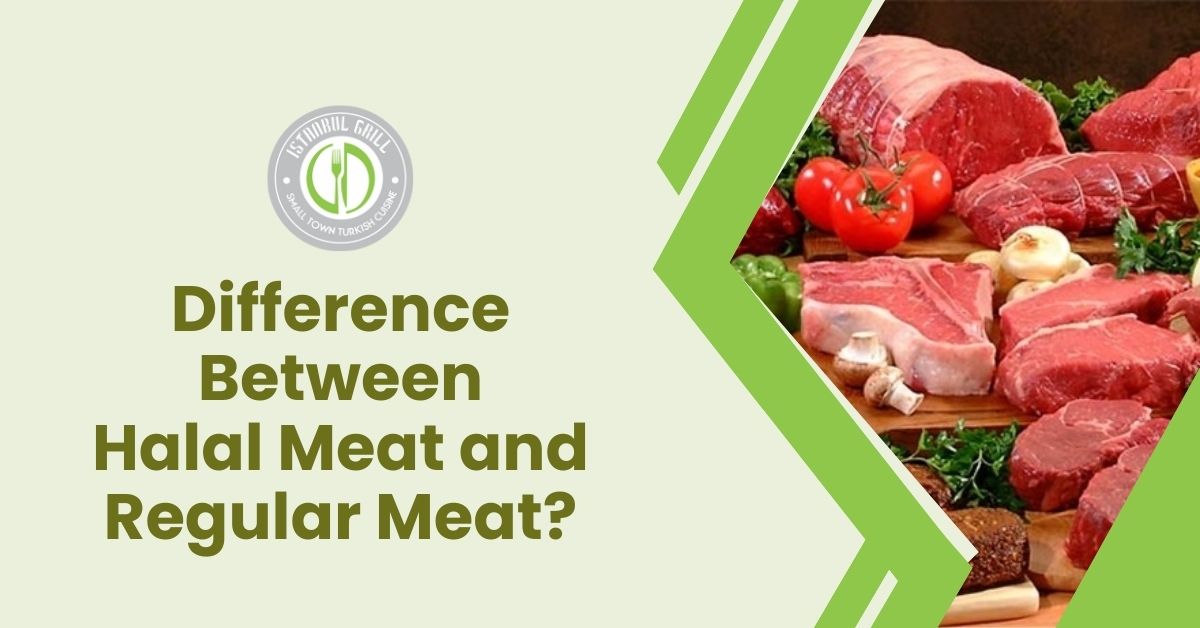
Regarding foods, anyone can question the use of Halal meat and regular meat. These terms go beyond mere choices in food but encompass cultural, religious, and even ethnic differences. Eating halal food meat is something that goes to the very kernel of Muslims’ beliefs; it is a part of their religion, Islam. However, the debate over halal and normal meat does not end with religious leaders and scholars alone. It’s about understanding what happens to the animal to produce the food. The scientific reasons for those things, and how they may alter or be reflected in the meat that ends up on your plate.
it is much more than labeling on the external surface of the package. It refers to a method of killing and butchering animals that is in line with the Sharia laws that are followed in Islam. This method disciplines cleanliness and the welfare of the animals that will be used to prepare the food consumed. On the other hand, normal meat is also known as non-halal or normal food. It is obtained through different procedures that may differ with region, culture, and business norms.
But which one is better? Does taste or quality differ greatly? Does it matter in terms of health or ethics? This article will focus on giving definitions of halal and non-halal food. It will enlighten you not only about its sacred aspect, covering both religious and cultural types, but also about how it differs in everyday consumption. By the end of each, you will be better positioned to choose between halal and normal food and other products you consume.
What is Halal Meat?
Halal meat is meat obtained from an animal that is slaughtered, processed, and handled according to Islamic dietary laws (Shariah). For meat to be considered halal, the animal must belong to a permissible species, be healthy and alive at the time of slaughter, and be slaughtered by making a swift cut to the throat that severs the jugular veins, carotid arteries, and windpipe with a sharp knife while reciting “Bismillah, Allahu Akbar” (“In the name of Allah, Allah is the Greatest”).
The blood must be completely drained from the animal because consuming blood is prohibited in Islam. Throughout its life and during slaughter, the animal must be treated humanely, provided with proper food and water, and protected from unnecessary stress or suffering. After slaughter, the meat must be processed, stored, transported, and packaged separately from non-halal products to prevent contamination. By following these religious and ethical requirements, the meat is considered halal and permissible for Muslims to consume.
What is Regular Meat?
What is more, regular meat can be any type of meat that is available in supermarkets or any eating places’ and does not have to be Halal or correspond to any set of rules. The methods of slaughter for Normal meat are widespread and differ with the country, the industry norms of that country, and the laws.
In traditional meat production, animals often go through stunning, where they are electrically stunned or gassed before being killed. This process is intended to make the animal unable to feel pain hence reducing the pain experienced by the animal. However, some voices oppose that stunning methods occasionally fail, thus the animals suffer for a long.
There is a great focus on efficiency and costs in Production. Fast turnover means many animals are slaughtered and their meat produced within a short time, and the main drive is to feed the market and not respect the beliefs of religion. Contrary to halal meats, in many cases, the blood is not completely removed from the animal’s body. Also, pork is considered a common meat that people in different countries consume frequently. While it is prohibited in the halal process.
In conclusion, normal meat production is like industrial standards with the goal of faster delivery of meat at a cheaper price. Hence, as much as kosher does not bear religious or ethical connotations like its Muslim counterpart. Halal is the benchmark, frankly practiced in regions where the Muslim religion is foreign.
Who Actually Certifies a Product as Halal?
“How do you actually know it’s halal?” comes down to one thing: which certifying body put its name behind it. In the US, the names that carry real weight are IFANCA (Islamic Food and Nutrition Council of America), the HFA (Halal Food Authority), and HMC (Halal Monitoring Committee), plus a handful of smaller regional certifiers that serve specific communities.
Each of these organizations sends inspectors to audit the slaughter process itself, the ingredient sourcing for anything processed afterward, and the physical separation between halal and non-halal products inside a facility, since cross-contamination on a shared production line can void certification even if the slaughter itself was done correctly.
You can see exactly what one of these certifiers actually checks by looking directly at IFANCA’s certification standards, which spell out their audit process for meat suppliers in detail rather than just slapping a logo on a package. This matters more than most people realize when they’re shopping on their own instead of eating out, knowing the difference between a real certification mark and a package that just says “halal” with nothing backing it up is exactly the kind of thing we break down in our full guide on how to buy real halal meat, including which logos to actually trust at a grocery counter.
What Actually Happens During Halal Slaughter?
The halal slaughter process, known as Dhabiha (or Zabiha), follows specific Islamic guidelines to ensure the meat is lawful for consumption. The process includes the following steps:
- Ensure the animal is eligible for halal slaughter. The animal must belong to a halal species, be healthy, alive, and free from visible illness or injury before slaughter.
- Treat the animal humanely. The animal should be handled calmly, provided with proper food and water, and protected from unnecessary stress or suffering before slaughter.
- Recite the prayer. Immediately before slaughtering each individual animal, the slaughterman recites “Bismillah, Allahu Akbar” (“In the name of Allah, Allah is the Greatest”), acknowledging that the animal’s life is taken with God’s permission.
- Perform a single swift cut. Using a sharp knife, the slaughterman makes one continuous cut across the throat, severing the windpipe, esophagus, and both jugular veins while leaving the spinal cord intact. This method is intended to minimize pain and allow efficient blood drainage.
- Drain the blood completely. After the cut, the animal’s blood is allowed to drain naturally and thoroughly, as consuming blood is prohibited under Islamic dietary laws.
- Prevent unnecessary distress. Animals should not witness the slaughter of other animals, and each animal must be slaughtered individually in a calm and controlled environment.
- Maintain halal handling standards. After slaughter, the meat must be processed, packaged, transported, and stored separately from non-halal products to prevent cross-contamination and preserve its halal status.
What is the Difference between Better Halal Meat and Regular Meat to Eat?
General:
Regarding the proposition that halal meat is better than regular meat, the judgment call involves one’s beliefs, ethics, and preferences. If you are a Muslim, then I think it’s obvious that you need to have whole foods halal meat. For non-Muslims, it may be a question of taste, health, or issues of animal rights, among others.
Taste:
As for the aspect of taste, some individuals opine that halal meat is tastier than its nonhalal counterpart due to how is processed. The act of bleeding out the animal is said to purge the meat. Therefore reduces the manifestation of toxins or any forms of impurities thereby making it cleaner. Some people may not even have any differences in the tastes of the normal and the halal meat they consume.
Health:
In the case of health, there might be some benefits to consuming halal meat. It minimizes the likelihood of dangerous bacteria surviving in the product. Since the blood of the animal is all let out in the process. But this does not in any way mean that normal meat is dangerous. Both halal and normal meat, if properly processed is safe for human consumption.
Ethical:
From an ethical consideration, some consider halal practices as saintlier due to the concern given to the welfare of an animal before and even during the time of slaughtering. Opponents of the normal meat business also brought forward in-farm practices that are crueler. It includes more limited space for the animals. However, this depends on the producer and the rules and regulations in the country of production.
Last of all, it is up to the consumer to decide whether to purchase halal or normal meat. Each method has its benefits and discussing which is better. Mostly depends on your dietary restrictions and morality as well as your taste buds.
How do you know if meat is halal?
Selecting lawful meat can be somewhat challenging sometimes, especially in non-Muslim countries where there are very few halal products. But there are some options to guarantee that the product with meat you are either buying or consuming is halal.
First, look for certification. Halal certification is proof that the food offered has been processed according to Islamic law. These certifications are usually offered by well-known Islamic bodies and are usually displayed on the outside package. The certification logo or stamp is your guarantee that the said meat is HALAL.
Third, if you are eating in a restaurant or buying meat from a butcher, don’t shy away from asking. Most of the halal butchers and restaurants will be proud to provide genuine halal food, and they will explain it to you. If one cannot explain it or obtain certification for whatever they are selling, then one should not buy.
A more specific measure is the store format that is used for a particular purchase. Some of the stores and markets that you get your groceries from may be owned by Muslims who sell only halal products. So this will be easier. Also, separate sections for halal food are visible in most of the giant supermarket stores. Therefore, increasing the chances of even consumers getting halal products.
Finally, avoid being drawn to a label that reads, ‘lawful-friendly’ or ‘lawful-style’ when it comes to the meat. These terms do not ensure that the intended meaning was prepared following the Islamic halal principles or rules. By undertaking to verify the authenticity of the product. Make sure to inquire for official certification where necessary. From this, customers should note that there is always a way of distinguishing between an imitation and an original product.
Conclusion
Therefore, halal and normal meat are opposite in the way that they are categorized both from a religious perspective as well as in terms of the method of slaughtering used and the animal’s treatment. The decision of having to choose between them separately is about personal inclinations, spiritual values, and other matters over ethics. This means knowing the differences between Halal food and regular meat, whether you choose to consume Halal meat. Because of religion or not makes better decisions on the types of meat to take.
FAQs
Is Halal food of better quality?
To those who are religiously inclined and are concerned with ethical ways of slaughtering the animals and the condition of cleanliness. People may consider halal food to be of better quality. However, quality issues relate closely to the producer and the handling of the finished products.
Is all meat in Muslim-majority countries automatically halal?
No. Imported or heavily processed products still need certification, since ingredients like gelatin, enzymes, or flavorings can quietly introduce non-halal components even in a Muslim-majority market.
Does halal meat cost more than regular meat?
Usually a little, yes, mainly because certified halal supply chains are smaller and require dedicated audits, hand-slaughter labor, and separate processing lines, all of which cost more to maintain than a standard high-volume line.