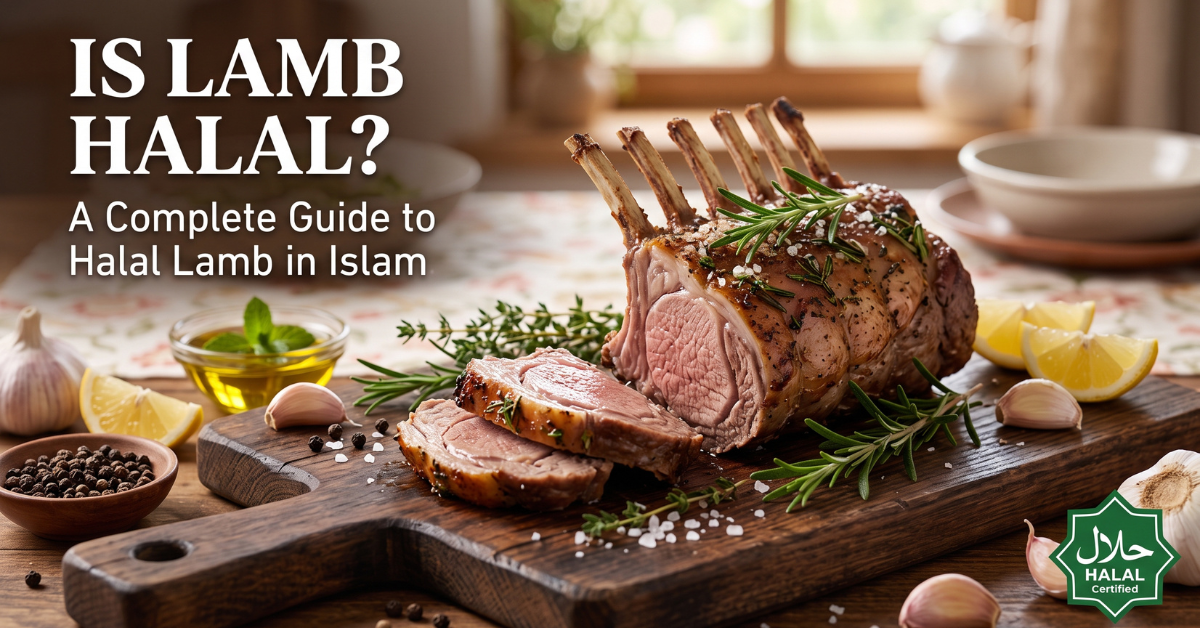
At Istanbul Grill Restaurant, lamb is one of our most beloved proteins. We serve it in kebabs, on platters, and as part of our traditional Turkish mezze spreads. Every piece of lamb we serve is certified halal. But we want our customers to fully understand why halal lamb matters and how to identify it confidently wherever they shop or dine.
This complete guide answers every question you have about halal lamb in Islam.
Is Lamb Halal in Islam?
Yes, lamb is halal in Islam. Sheep are among the animals explicitly referenced as permissible in the Quran and Hadith, and all four major Sunni schools of Islamic law (Hanafi, Maliki, Shafi’i, and Hanbali) classify sheep as halal without any disagreement.
However, this is where many people make a critical mistake. Just because lamb comes from a sheep does not automatically make it halal. The animal may be permissible, but the meat only becomes truly halal when it is slaughtered and handled according to Islamic law.
As we explain in our comprehensive guide on what are the haram foods in Islam, beef, lamb, goat, and venison are all permissible when slaughtered according to the zabiha method. The key word is “when.” Without proper slaughter, even a permissible animal produces haram meat.
Why Lamb Has a Special Place in Islamic Tradition
Lamb holds a particularly important position in Islamic history and practice that goes beyond everyday eating.
The Prophet’s Example
The Prophet Muhammad (peace be upon him) sacrificed sheep on Eid al-Adha, the Festival of Sacrifice. This is the most direct and powerful confirmation of lamb’s halal status in Islamic tradition. When Muslims around the world perform qurbani (the ritual sacrifice of an animal during Eid al-Adha), lamb and sheep are among the most commonly chosen animals.
This annual tradition has been observed for over 1,400 years and connects every Muslim who participates to the same practice the Prophet himself performed.
Referenced in the Quran
Sheep are mentioned in the Quran in the context of the blessings Allah has given to humanity. The Quran states in Surah Al-An’am (6:143): “Eight pairs: of the sheep two, and of the goats two.” This verse, which discusses permissible animals, confirms that sheep are among the animals Allah has made lawful for Muslims to eat.
Lamb in Ottoman and Turkish Culinary Tradition
At Istanbul Grill Restaurant, lamb has been central to our cooking tradition for centuries. Ottoman cuisine elevated lamb to an art form, developing hundreds of preparations from slow-roasted whole lamb to intricately spiced ground lamb kebabs. This tradition is alive in everything we cook today.
The Four Conditions That Make Lamb Halal
Understanding what makes any meat halal is essential for making correct food choices. Our detailed guide on what makes meat halal covers this in full, but here is a focused summary for lamb specifically.
Condition 1: The Animal Must Be Permissible
Sheep are a permissible animal in Islam. This condition is automatically satisfied for all lamb and mutton. However, the lamb must be a domestic sheep. Wild animals that are permissible require specific conditions to hunt and slaughter.
Condition 2: The Animal Must Be Alive and Healthy at the Time of Slaughter
The lamb must be alive, healthy, and free from disease when slaughter begins. An animal that died before proper slaughter, regardless of the cause, cannot produce halal meat. This is non-negotiable.
This condition also protects food safety. Healthy animals produce cleaner, safer meat, which aligns with Islam’s emphasis on consuming only what is tayyib (wholesome and pure).
Condition 3: The Name of Allah Must Be Invoked
Before making the cut, the person performing the slaughter must say “Bismillah, Allahu Akbar” (In the name of Allah, Allah is the Greatest). This invocation is mandatory for each individual animal.
The Quran is direct about this requirement in Surah Al-An’am (6:121): “Do not eat of that over which the name of Allah has not been mentioned, for it is surely an abomination.” If the name of Allah is not invoked, the meat becomes haram regardless of the slaughter method used.
Condition 4: Proper Zabiha Slaughter Must Be Performed
The Islamic slaughter method is called zabiha (also spelled dhabiha). For lamb, this means a trained Muslim slaughterman uses a very sharp knife to make one swift, clean cut that severs the windpipe, esophagus, and both carotid arteries and jugular veins simultaneously.
The spinal cord must not be severed at this stage, as this would stop the heart from beating and prevent proper blood drainage.
All blood must then be allowed to drain completely from the carcass. This is a Quranic requirement from Surah Al-Baqarah (2:173), which prohibits the consumption of blood. Complete blood drainage also improves the meat’s freshness, cleanliness, and shelf life.
What Makes Lamb Haram
Understanding what can make lamb haram helps you avoid mistakes when shopping or dining out.
| Situation | Halal Status | Reason |
|---|---|---|
| Lamb slaughtered by a Muslim with Allah’s name invoked | Halal | All conditions met |
| Lamb slaughtered without invoking Allah’s name | Haram | Missing mandatory invocation |
| Lamb that died before slaughter | Haram | Carrion is explicitly forbidden |
| Lamb slaughtered by improper stunning that caused death | Haram | Animal not alive at time of cut |
| Lamb cross-contaminated with pork during processing | Haram | Contact with forbidden substance |
| Lamb cooked with alcohol | Haram | Alcohol is forbidden |
| Lamb from an uncertified source with unknown process | Mashbooh (doubtful) | Cannot verify conditions were met |
When something is mashbooh (doubtful), the general Islamic principle is to avoid it. The Prophet Muhammad (peace be upon him) said in the hadith recorded in Sahih al-Bukhari: “That which is lawful is clear and that which is unlawful is clear, and between the two are doubtful matters. He who guards against doubtful things keeps his religion and his honor blameless.”
The Stunning Debate: What Every Muslim Should Know
One of the most important and debated topics in halal lamb certification is whether pre-slaughter stunning is acceptable in Islam.
What is Stunning?
Stunning means rendering the animal unconscious before cutting its throat. This is done using an electric shock (electrical stunning), a bolt fired into the head (captive bolt stunning), or gas. Many Western countries legally require stunning for all commercial slaughter as an animal welfare measure.
The Traditional View: Stunning is Not Permitted
Traditional Islamic scholars say that stunning is not compatible with zabiha requirements because the animal must be fully alive and conscious when its throat is cut. If the stunning kills the animal before the cut is made, the meat is haram because it becomes carrion.
Organizations like the Halal Monitoring Committee (HMC) in the United Kingdom and many scholars in the Muslim world only certify non-stunned meat as halal.
The Moderate View: Reversible Stunning May Be Acceptable
Some modern Islamic scholars and organizations say that light, reversible stunning is permissible as long as:
- The animal is still alive when its throat is cut
- The stunning does not cause death
- Blood drainage still occurs properly
- The name of Allah is still invoked
Organizations like the Halal Food Authority (HFA) accept certain forms of reversible stunning under these conditions.
What Should You Do?
If this issue matters to you, check which certification body has certified the lamb you are buying and research that organization’s specific policy on stunning. The most conservative choice is to buy from suppliers certified by organizations that require non-stunned slaughter.
At Istanbul Grill Restaurant, we are transparent about our suppliers and certification. Our customers are always welcome to ask about our sourcing.
Halal Lamb Nutrition Facts
Beyond its religious permissibility, halal lamb is also a nutritious protein choice. Here is the nutritional profile for a 3-ounce (85g) cooked serving of lean lamb:
| Nutrient | Amount | % Daily Value |
|---|---|---|
| Calories | 175 | – |
| Protein | 23g | 46% |
| Total Fat | 8g | 10% |
| Iron | 1.9mg | 11% |
| Zinc | 4.4mg | 40% |
| Vitamin B12 | 2.2mcg | 92% |
| Selenium | 27mcg | 49% |
| Niacin (B3) | 6mg | 38% |
Source: USDA FoodData Central
Lamb is particularly rich in zinc, which supports immune function and wound healing, and vitamin B12, which is essential for nerve health and red blood cell formation. The complete blood drainage required in halal slaughter also means halal lamb tends to have a cleaner flavor and longer freshness compared to conventionally slaughtered meat.
Common Misconceptions About Halal Lamb
“All lamb sold in Muslim countries is automatically halal”
Not necessarily. While Muslim-majority countries have stronger cultural norms around halal slaughter, this does not guarantee that every product meets all requirements. Always look for certified halal verification even when purchasing in Muslim-majority areas.
“Organic lamb is the same as halal lamb”
These are two completely separate certifications. Organic refers to how the animal was raised (without antibiotics or hormones, on organic feed). Halal refers to how it was slaughtered and handled. Lamb can be organic but not halal, halal but not organic, both, or neither. If you need both certifications, look for products that carry both labels.
“Lamb at any Middle Eastern restaurant is halal”
Never assume. Middle Eastern or Turkish ownership of a restaurant does not automatically mean the food is halal-certified. Always ask to see halal certification, and ask specifically about the meat supplier. At Istanbul Grill Restaurant, we are proud to show our certification and explain our sourcing to any customer who asks.
“If the butcher is Muslim, the lamb is halal”
A Muslim butcher is a good start, but it is not sufficient on its own. The butcher must follow all zabiha requirements, including invoking Allah’s name, using the correct slaughter method, and ensuring complete blood drainage. They must also prevent cross-contamination during processing. A Muslim butcher who does not follow these steps does not produce halal meat.
“Lamb is halal but mutton is not”
Both lamb and mutton come from sheep. Lamb refers to meat from young sheep (under one year old), while mutton comes from adult sheep. Both are halal when slaughtered correctly. The age of the animal does not affect its permissibility.
How to Find and Buy Halal Lamb in the USA
Finding certified halal lamb in America has become significantly easier as demand has grown.
Dedicated Halal Butcher Shops
The most reliable place to buy halal lamb is a dedicated halal butcher shop. These businesses specialize in halal meat and typically have strong relationships with certified suppliers. Staff can answer detailed questions about the slaughter process, certification body, and sourcing.
To find halal butchers near you, search online, ask at your local mosque, or check community social media groups.
Supermarkets and Grocery Chains
Many mainstream American grocery stores now carry halal lamb, particularly in areas with significant Muslim populations. Look for clearly labeled halal products with certification logos. Do not rely on unlabeled “natural” or “organic” claims as a substitute for halal certification.
Online Halal Meat Delivery
Several companies now deliver certified halal lamb directly to homes across the USA. This is particularly useful for people in areas with limited local options. Always verify the certification body and read customer reviews from other Muslim consumers before ordering.
Halal Restaurants Like Istanbul Grill
At Istanbul Grill Restaurant, all our lamb is sourced from certified halal suppliers. Whether you order a lamb kebab, a lamb chop platter, or lamb kofta, you can eat with complete confidence that every step from the farm to your plate followed Islamic standards.
Browse our full selection of halal lamb dishes on our Istanbul Grill menu before your visit.
How Halal Lamb is Used in Turkish Cuisine
At Istanbul Grill Restaurant, lamb is central to our most beloved traditional dishes. Here are some of the ways we honor this ingredient:
- Adana Kebab – Ground lamb mixed with red pepper and spices, shaped around a flat metal skewer and grilled over charcoal. Named after the city of Adana in southern Turkey, this is one of the most iconic Turkish kebabs.
- Shish Kebab – Marinated cubes of lamb shoulder threaded onto skewers and grilled to perfection. The marinade of olive oil, lemon juice, garlic, and warm spices makes every bite tender and flavorful.
- Lamb Chops – Seasoned with Turkish spices and grilled over high heat, lamb chops are a show-stopping dish that showcases the natural richness of the meat.
- Kofta – Spiced ground lamb shaped into oval patties and grilled. Served with rice, salad, and our house-made sauces.
- Beyti – Ground lamb wrapped in lavash bread, baked, and served with tomato sauce and yogurt. A beloved dish in Turkish restaurants across America.
All of these dishes connect you to a culinary tradition that has been celebrating halal lamb for centuries. Understanding the halal standards behind the ingredients makes each meal even more meaningful.
Eat Authentic Halal Lamb at Istanbul Grill Restaurant
Lamb has been at the heart of Turkish and Islamic culinary tradition for over a thousand years. At Istanbul Grill Restaurant, we take the responsibility of serving truly halal lamb very seriously because we know it is not just food for our Muslim customers. It is an act of following their faith.
Every lamb dish on our menu is prepared with certified halal meat, handled in a halal kitchen, and cooked with the care and respect this ingredient deserves. From our adana kebabs to our lamb chops, you can eat with complete confidence.
Visit us in Orlando or Kissimmee and experience authentic Turkish halal lamb the way it was always meant to taste. Browse our complete menu before your visit and come hungry.
Is lamb halal in Islam?
Yes, lamb is halal in Islam. Sheep are among the animals explicitly permitted in the Quran and Hadith, and all four major Sunni schools of Islamic law agree on their permissibility without exception. However, the lamb only becomes halal for consumption when it is slaughtered according to Islamic zabiha requirements, with the name of Allah invoked and all blood properly drained. Simply being meat from a sheep is not enough.
Is all lamb sold in stores halal?
No. Lamb sold in regular American supermarkets is not halal by default. Most commercially raised and slaughtered lamb in the United States follows USDA regulations but not Islamic zabiha requirements. Always look for certified halal labels from recognized organizations like IFANCA, ISA, or other credible certification bodies.
Can Muslims eat lamb at any restaurant?
Not automatically. Unless a restaurant specifically states that their lamb is halal certified and can show documentation, Muslim diners should not assume the lamb is halal. Always ask about halal certification and the supplier before ordering. At Istanbul Grill Restaurant, all our lamb is certified halal.
What is the difference between halal lamb and regular lamb?
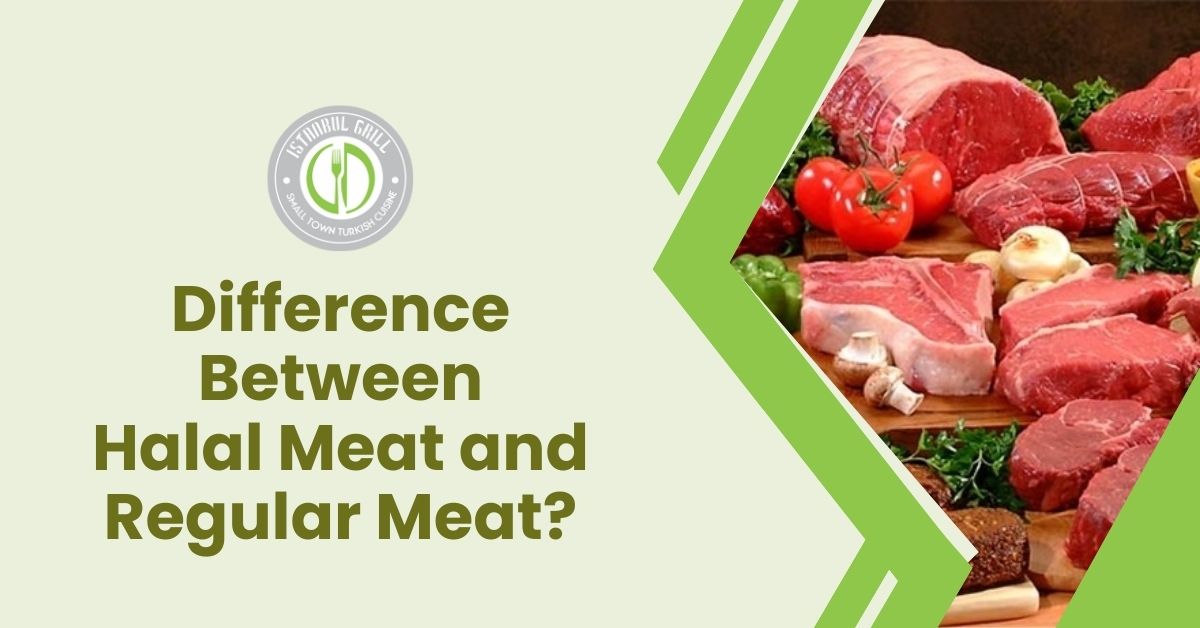
The primary difference is the slaughter method. Halal lamb is slaughtered by a Muslim who invokes Allah's name, using the zabiha method that requires severing specific blood vessels and allowing complete blood drainage. Regular commercial lamb typically involves different slaughter methods, often with pre-slaughter stunning, and does not include the religious invocation. Many Muslims also report that halal lamb has a cleaner, less gamey flavor due to the complete blood drainage.
Is organic lamb the same as halal lamb?
No. Organic and halal are completely separate certifications. Organic refers to farming practices (no antibiotics, hormones, or non-organic feed). Halal refers to the slaughter method and handling process. You need both certifications separately if you want lamb that is both organic and halal.
How can I tell if lamb is truly halal?
Look for a halal certification logo on the packaging from a recognized organization. The label should include the certifying body's name and a certification number. At restaurants, ask to see their halal certificate and ask about their supplier. When in doubt, contact the certifying organization directly to verify.